

The Invisible Treadmill: Why 1099s are Exhausted

You know the feeling. It is 2:00 AM, and you are staring at the ceiling. Your mind is a carnival of “did I send that invoice?” and “I forgot to follow up with that lead.” You worked twelve hours today. You are exhausted. Yet, if someone asked what you actually achieved to move your business forward, you would struggle to find an answer.
This is the invisible treadmill. It is the hallmark of the “Mentally Unconscious” professional. In the world of the 1099 entrepreneur, where you eat what you kill, being unconscious is not just a personal problem. It is a business failure. When you are not Mentally Awake, you are driven by the urgent rather than the important. You are running at full speed, but you are not actually going anywhere.
The Cost of Being Mentally Unconscious

In the Mentally Awake system, we talk about the Five Pillars that form your foundation. When you stay on the treadmill, you are actively eroding these pillars, specifically your Resources and your Resilience.
Your Resources consist of your Time, Talent, and Treasure. Time is your most precious, non-renewable asset. When you spend your day responding to every “quick question” or social media ping, you are throwing your Treasure into a bottomless pit. You are busy, but you are not necessarily productive.
Furthermore, the constant “on” state of the modern 24/7 news and notification cycle leads to a massive drain on your Resilience. This Pillar is your “shock absorber”. Without it, the normal bumps of 1099 life, like a ghosted proposal or a late payment, do not just annoy you. They crush you. This leads to a cycle of exhaustion where it becomes hard to think clearly. You become a leaf blown by the winds of distraction instead of the captain of your own ship.
Shifting from Chaos to Mastery
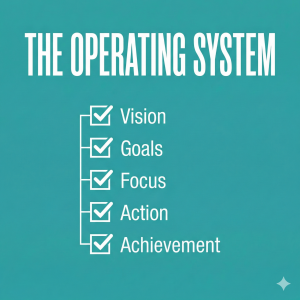
To get off the treadmill, you must stop reacting and start directing. You need to transition from “doing” busy things to “being” Mentally Awake. Here are three tools from the Mentally Awake Processes to help you stop the leak.
1. The Vision-to-Goal Translator Goals are the destinations on your map. Many 1099s have a vague desire to “make more money,” but that is not a destination. It is a wish. Take your long-term Vision and translate it into Destination Goals. For example, instead of “growing your business,” set a goal to “onboard three new retainer clients by the end of the quarter.” This provides the spotlight you need to filter out distractions.
2. Time Blocking for Deep Work Focus is a superpower in a distracted world. Most entrepreneurs spend their day in “Shallow Work,” which is logistical and non-demanding. To build a stable business, you must prioritize Deep Work. Schedule specific blocks in your calendar where your phone is on “Do Not Disturb” and your only task is your highest priority goal. Treat these appointments with yourself as sacrosanct.
3. The Two-Minute Rule Often, the treadmill is powered by a thousand tiny tasks that clutter your mind. As outlined in Process 4 regarding Action, if a task takes less than two minutes, do it immediately. Do not put it on a list. Do not “think about it” later. Clear these small, nagging items out to create quick wins and build momentum for the big projects that actually generate Treasure.
Conclusion: Stop the Drift
Being a 1099 professional should mean freedom, not a life sentence to a treadmill you cannot stop. If you feel like you are running on autopilot without being fully aware of what is going on, you are mentally unconscious. It is time to reclaim your mind, your time, and your life.
Are you ready to see how much chaos is actually costing you? Take the Mentally Awake assessment to find your “Unconsciousness Score” and identify exactly where your Pillars are wobbling.
Are you building a scalable business or just a high-stress job?
Most independent professionals are one bad month away from a crisis. Stop the “Feast or Famine” cycle and get a clear roadmap for your business.
Mark Sharman is the founder of Mentally Awake, a growth system designed to help 1099 entrepreneurs move from “Job to Business.”