
Beyond the Permit Office: Stop Waiting for Permission and Reclaim Your Direction
You finally did it. You left the cubicle, ditched the manager who didn’t understand your value, and stepped into the world of the 1099 entrepreneur. You are officially the boss. Yet, if you are anything like me during my first year in business, you might notice a strange lingering feeling. You find yourself waiting. You wait for the phone to ring with a “directive.” You wait for a client to give you the “okay” to start a project you know they need. You wait for the market to feel “safe” before you invest in your own growth.
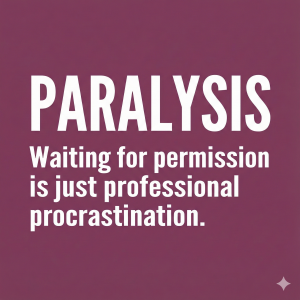
This is what I call the “Permit Office” syndrome. Even though you own the company, you are still walking down the hallway of your mind, looking for a supervisor to sign off on your daily actions. For the 1099 professional, this is the most dangerous form of being mentally unconscious. In the corporate world, waiting for permission is called being a good employee. In the entrepreneur world, waiting for permission is called going out of business.
The shift from an employee mindset to an owner mindset is not about changing your tax status. It is about changing your internal operating system. It is about moving from a state of “mentally unconscious” reacting to a state of being truly Mentally Awake.
The Hidden Cost of Mental Unconsciousness
When we operate with an employee mindset, we are essentially running on autopilot. We look for external cues to tell us what is important. We spend our days reacting to the urgent emails, the buzzing notifications, and the demands of others. This leads to a state of overwhelm where we feel less productive and more stressed than ever before.
The cost of this “unconsciousness” shows up most clearly in Pillar 2: Resilience. When you think like an employee, a setback feels like a reprimand from the universe. If a lead doesn’t close or a marketing campaign fails, the employee mindset says, “I did something wrong, and I should wait for instructions on how to fix it.” This causes your stress load to increase and your ability to remember your original vision to decrease.
True owners understand that they are responsible for what they choose to do. They do not see failure as a catastrophe. They see it as data. If you are waiting for perfect weather conditions before you launch your rocket, you will spend your whole life sitting in the driveway while other rockets blast off around you.
Pillar 1: Reclaiming Your Direction
To move from employee to owner, you must first master Pillar 1: Direction. An employee follows a map drawn by someone else. An owner knows their “True North” and develops the skills to navigate toward it.
Ask yourself this question: If it were the year 2075 and you were looking back at your life, what are the one or two things you absolutely must have achieved to feel satisfied? An employee works for Friday. An owner works for that 2075 legacy.
When you have a strong sense of Direction, you gain the clarity needed to prioritize your energy. You no longer ask, “What does my boss want me to do today?” Instead, you ask, “What actions will move me closer to my ultimate destination?” This shift in perspective is the difference between being a “Filing Guy” who manages tasks and a “Carny” who creates a world of excitement, or finding that perfect balance between the two.
Process 4: Taking Owner-Level Action
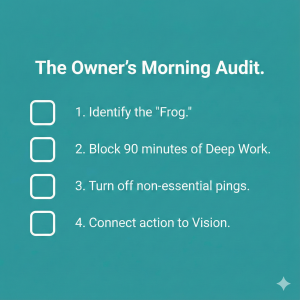
Once you have your Direction, you must engage Process 4: Action. The biggest hurdle for the 1099 entrepreneur is inertia. We tell ourselves we are too busy or that we don’t have enough time. The truth is that we are often just “productively procrastinating” by doing low-value tasks that feel like work but don’t move the needle.
Owners use specific tools to bridge the gap between knowing and doing. One of the most effective is the “Five-Minute Rule.” If a task is aligned with your goals, commit to acting on it for just five minutes. Often, once you start, the motivation follows the action.
Another owner-level strategy is “Eating the Frog.” You identify your most important, most challenging task and you tackle it first thing in the morning. Employees save the hard stuff for last because they hope someone will tell them they don’t have to do it. Owners do the hard stuff first because they know they are the only ones who can.
Pillar 3: Managing Your Talent and Treasure
Finally, an owner takes full responsibility for Pillar 3: Resources. You must view your time, talent, and treasure as assets to be grown, not just spent. An employee sees a training course as “something my company should pay for.” An owner sees a training course as an investment in their primary engine: themselves.
You have a limited amount of biological fuel. If you spend your morning scrolling through social media, you are throwing away the attention you need for deep work. Owners treat their attention like the precious, finite resource it is. They use time blocking to protect their deep work hours from the “Shallow Work” that keeps the lights on but never builds the dream.
Choose Your Journey

The transition to a Mentally Awake owner mindset is a process, not an event. You are building the software and the operating system of your life simultaneously. It is time to stop waiting for the green light. It is time to realize that you are the one holding the remote control to the traffic signal.
Where do you need to start today?
Are you building a scalable business or just a high-stress job?
Most independent professionals are one bad month away from a crisis. Stop the “Feast or Famine” cycle and get a clear roadmap for your business.
Mark Sharman is the founder of Mentally Awake, a growth system designed to help 1099 entrepreneurs move from “Job to Business.”