
Stop Managing People Who Don’t Work for You
You know the feeling. It usually hits on a Tuesday afternoon.
You look at your team roster. You see twenty names. On paper, you have a robust team. You have “agents.” You have a “territory.” You have a “structure.”
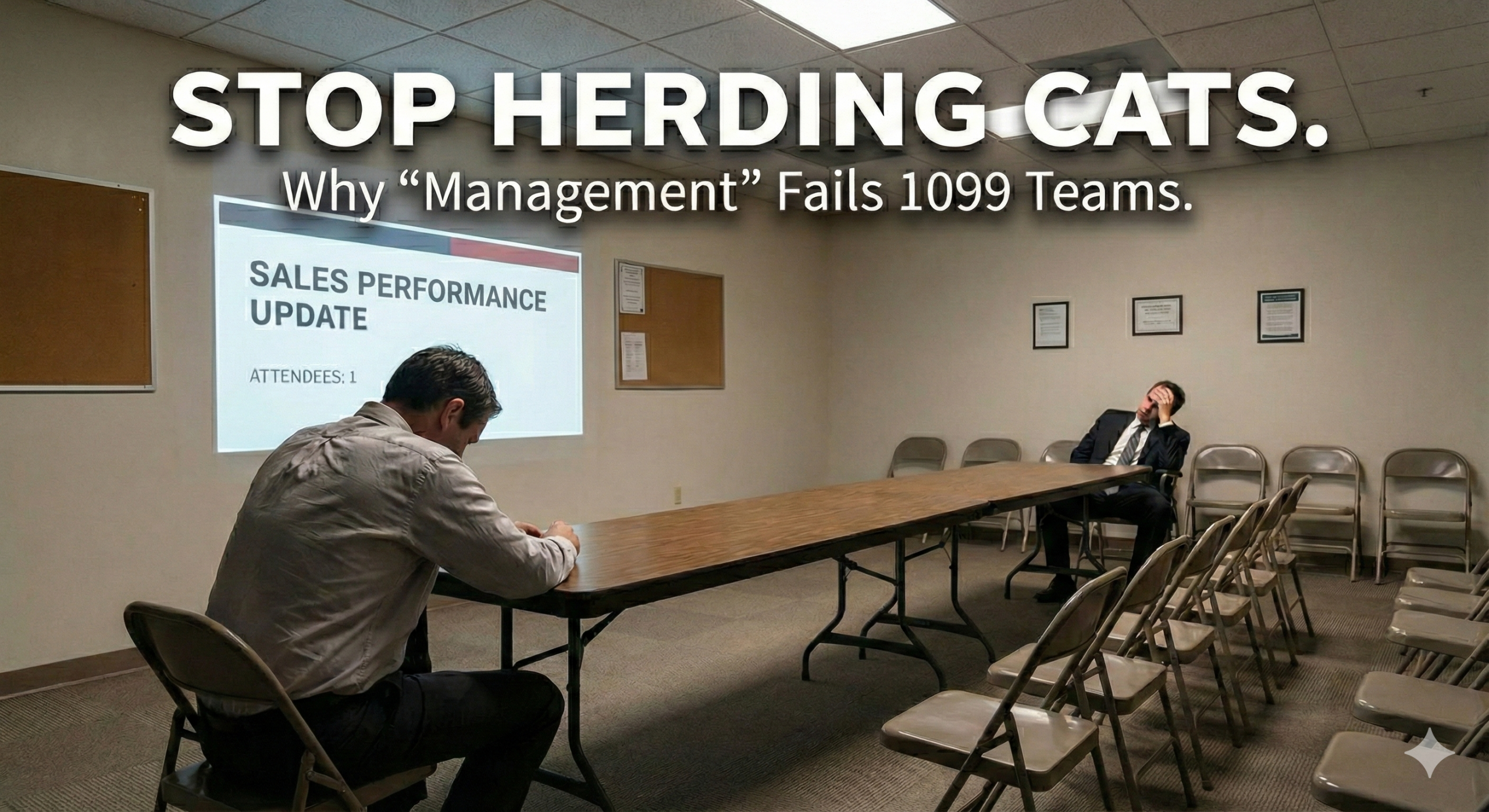
But when you look at the production report, you see three names doing all the work. When you schedule a mandatory training meeting, five people show up (and two leave early). When you call that promising new recruit to ask why they haven’t logged any activity in the CRM for three days, it goes straight to voicemail.
You feel ignored. You feel powerless. And eventually, you feel angry.
“I gave them the training,” you think. “I gave them the leads. I gave them the system. Why won’t they just do the work?”
If you lead a team of independent contractors, real estate agents, or direct sales professionals, this is the single greatest source of your stress. You feel like you are herding cats.
I am here to tell you that the stress isn’t coming from your team’s laziness. It is coming from your own misunderstanding of the game you are playing.
You are trying to manage employees. But you don’t have employees. You have volunteers who get paid on performance. And until you change your leadership operating system to match that reality, you will remain in a permanent state of frustration.
The Misdiagnosis: “They Just Need More Accountability”
When a team of 1099 contractors isn’t performing, the standard reaction is to tighten the grip.

You’ve likely seen (or done) this before. The numbers dip, so leadership announces a “Back to Basics” initiative.
- “Everyone must be in the office by 8:00 AM.”
- “Everyone must log 20 contacts into the tracker by noon.”
- “Mandatory Monday Morning Motivation calls.”
You try to manage them like a sales manager at a software company manages a salary-plus-commission sales team. You try to force compliance.
Here is the trap: 1099 professionals trade security for autonomy.
That is the deal. They gave up the safety of a bi-weekly paycheck, health benefits, and paid vacation specifically because they did not want a boss telling them when to take a lunch break.
When you attempt to micromanage a 1099 agent, you are violating the core psychological contract of their employment. You are removing the one thing they value most: their freedom.
The moment you start acting like a “Boss”—demanding reports, inspecting activity, requiring attendance—you aren’t leading them. You are repelling them. They didn’t leave their corporate job to come work for you. They came to work for themselves.
If you treat a sovereign business owner like a rebellious employee, they will exercise the only power they have: they will ignore you.
The Real Diagnosis: A Failure of Vision and Partnership
The problem isn’t that your people lack discipline (though many do). The problem is that you are trying to lead through authority rather than alignment.
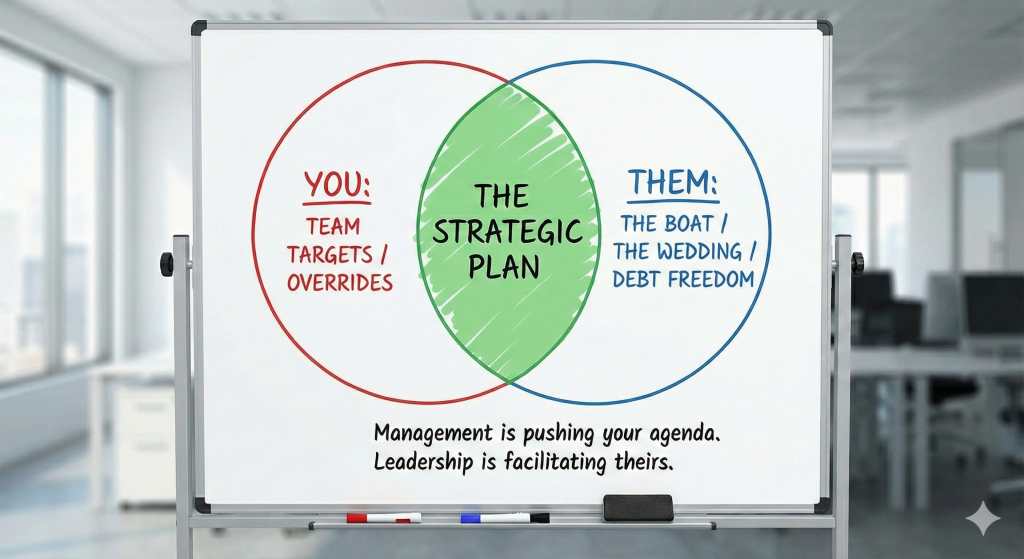
In the Mentally Awake System, we define this as a breakdown in Process 2: Goals.
You have a goal (hit your team override target). You assume your agent has a goal (make money). But you have never actually aligned those two things into a shared vision.
When you call an agent to nag them about their activity, you are speaking from your need, not theirs. You sound like a bill collector for their time.
- The Boss says: “You need to make 20 calls today because that’s the standard for my team.” (The agent hears: I need to work harder so you can get your bonus.)
- The Partner says: “You told me you wanted to make $5,000 this month to pay for your daughter’s wedding. To do that, the math says we need 20 calls today. Are we still fighting for that wedding?” (The agent hears: You are holding me accountable to my own dream.)
See the difference?
One is management. The other is leadership.
The Mentally Awake leader understands that they are not a manager of people; they are a strategic consultant to independent businesses.
Your agents are not your staff. They are your B2B clients. Your “product” is the system and support that helps their business grow. If they aren’t buying your product (listening to your advice), it’s not because they are bad employees. It’s because you haven’t proven that your advice helps them reach their destination.
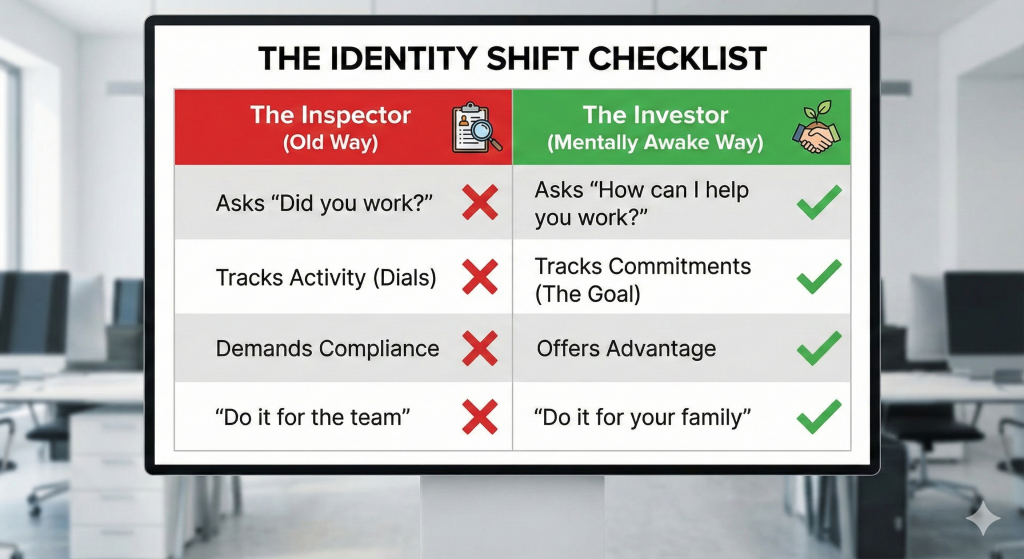
The Prescription: From “Inspector” to “Investor”
If you want to stop herding cats and start leading lions, you need to fundamentally change the dynamic of your relationship. Here is the three-step prescription to shift from an exhausted Manager to a wealthy Partner.
1. The “Re-Hiring” Conversation (The Vision Reset)
Stop the “activity checks” immediately. Instead, schedule a 30-minute strategy session with every producing member of your team.
Sit them down and ask: “Why are you doing this?”
This is Pillar 1: Direction. Do not accept “to make money” as an answer. Dig deeper. Is it to fire their spouse from a job they hate? Is it to buy a boat? Is it to just pay off credit card debt?
Once they tell you the goal, you work backward to the math.
- “Okay, to buy that boat by June, you need $4,000 extra a month. That means 4 new clients. That means 15 presentations. That means 60 contacts.”*
Now, you have a contract. “My job is to help you get the boat. Do I have your permission to push you when you fall behind on the ‘Boat Plan’?”
Now you aren’t nagging. You are partnering.
2. Stop Tracking Activity; Start Tracking Commitments
As a leader, your time is your most precious asset (Pillar 3: Resources). Stop wasting it on people who aren’t working.
In my coaching, I teach leaders to stop chasing the bottom 80% of their roster. It sounds harsh, but you cannot want it more than they do.
Set a standard: “I invest my time in entrepreneurs who invest in their business.”
If an agent ghosts you or misses their commitments two weeks in a row, stop calling them. Send them a polite text: “Hey, it seems like the timing isn’t right for you to go full throttle. I’m going to step back and let you handle your schedule. Let me know when you’re ready to run again.”
Then, take all that energy and pour it into the agents who are working. This shifts the dynamic. Access to you becomes a prize for performance, not a punishment for laziness.
3. Be a Resource, Not a Boss
A 1099 professional doesn’t need a boss; they need a competitive advantage.
If you want them to pick up the phone when you call, you must be the person who makes their life easier, not harder.
- Bad Leader: Calls to ask, “Did you make your dials?”
- Mentally Awake Leader: Calls to say, “I just found a new response for the ‘we are happy with our current vendor’ objection that is working really well. I sent it to you. Try it out this afternoon.”
Be the Pillar 3 resource provider. Give them systems. Give them tools. Give them the “Mentally Awake” strategies that move them from “Invisible to Invaluable.”
The Prognosis
When you stop trying to manage your team and start treating them like strategic partners, two things happen.
First, the ones who were never going to make it will quit faster. This is good. It clears the dead weight and frees up your mental bandwidth.
Second, the producers—the ones you actually want to keep—will bond to you. They will see you not as the annoying corporate overlord, but as the indispensable mentor who helps them achieve their vision.
You can build a hierarchy of subordinates, or you can build an empire of entrepreneurs. The former requires you to work 80 hours a week dragging people uphill. The latter requires you to be Mentally Awake.
Stop managing. Start leading.
Are you building a scalable business or just a high-stress job?
Most independent professionals are one bad month away from a crisis. Stop the “Feast or Famine” cycle and get a clear roadmap for your business.
Mark Sharman is the founder of Mentally Awake, a growth system designed to help 1099 entrepreneurs move from “Job to Business.”